

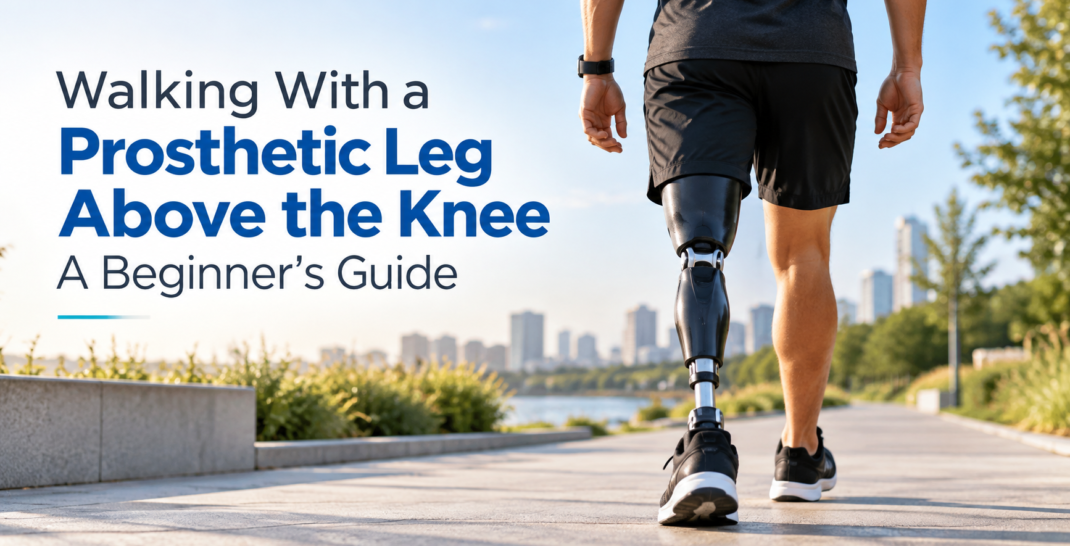
Here’s something nobody tells you before an above-knee amputation: relearning to walk isn’t really about the leg. It’s about your brain figuring out how to trust a joint it can’t feel anymore. At Amputee Clinic, we’ve watched hundreds of patients go through this exact process, and the ones who do best aren’t necessarily the strongest or the youngest. They’re the ones who stop expecting a straight line to “normal” and just keep showing up to therapy.
So let’s talk about what actually happens in those first weeks and months, because the version most people picture in their head (walk out of surgery, get a leg, walk normally) isn’t how it goes.
Why Above-Knee Walking Is Different From Below-Knee Walking
Below-knee amputees keep their real knee. That joint quietly handles balance and shock absorption without anyone thinking about it. Take that joint away, and suddenly a mechanical part has to do a job your nervous system used to run on autopilot.
This is why above-knee (transfemoral) walking burns more energy, sometimes a lot more, than walking with a below-knee prosthesis or with two natural legs. Physical therapists who specialize in AKA gait training will tell you the same thing: patients need more hip strength, more core control, and more patience than lower-level amputees. The knee and the muscles that used to stabilize it are gone, so the glutes and hips pick up the slack. That’s exactly why early sessions spend so much time on hip work and weight-shifting before anyone even attempts a full step.
A big part of how well this stage goes comes down to the device itself. At Amputee Clinic, our above the knee prosthetics are shaped around a person’s socket fit and activity level rather than a generic mold, which makes the early weight-bearing phase noticeably less frustrating.
Learning to Walk for the First Time
Every patient’s path looks a bit different. But there’s a general order things tend to happen in.
First comes the parallel bars. Nobody skips this part. Patients lean on their arms and practice standing, shifting weight side to side, while their body starts figuring out how to load through the socket without collapsing.
From there, it’s weight-bearing drills: small, deliberate exercises that teach the residual limb to accept real weight instead of the sound leg quietly doing all the work out of habit.
A walker or a cane usually comes next. Not forever, just long enough to build confidence between “holding onto bars” and “walking free.” Somewhere in here, a good therapist is also watching closely for bad habits creeping in, like hip hiking or that outward swing of the leg called circumduction, and catching them before they turn into permanent patterns.
Eventually, support gets pulled back. Slowly. Flat ground first, then stairs, ramps, grass, gravel — whatever real life throws at someone.
One thing worth saying plainly: being scared of falling is normal. Almost everyone feels it. It fades, usually, as the brain starts believing the leg will actually hold.
So, How Long Does This Actually Take?
Honestly? It depends. Age, general health, how the residual limb heals, and how fast the socket gets dialed in all matter. But if you want something to anchor your expectations to, here’s a rough breakdown based on what we typically see.
|
Recovery Stage |
Typical Timeframe |
What’s Happening |
|
Healing and limb shaping |
4 to 8 weeks after surgery |
Swelling drops, limb shape stabilizes for the first fitting |
|
First prosthetic fitting |
2 to 3 months post-op |
Preparatory prosthesis fitted, adjusted, refitted |
|
Basic gait training |
1 to 3 months after fitting |
Bars, weight-shifting, walker or cane practice |
|
Walking independently on flat ground |
3 to 6 months after fitting |
Less device dependence, gait smooths out |
|
Full adjustment |
6 to 12+ months |
Stairs, uneven ground, back to normal daily life |
Most people get their first real fitting somewhere in that three-to-six-month window after amputation. Full comfort, meaning walking without thinking about it, tends to land closer to the one-year mark, sometimes further out for above-knee amputees specifically. There’s simply more to rebuild without a natural knee doing part of the job.
Problems You’ll Probably Run Into (And That’s Okay)
A few things come up again and again, no matter how well the rehab goes:
Your limb volume won’t stay the same. It shrinks, swells, shrinks again, especially in year one, which means socket adjustments are just part of the deal. This is one reason our custom prosthetics patients rely on matter so much early on, since a socket built around your specific limb shape at Amputee Clinic holds up better through those changes than an off-the-shelf option.
Sweating and skin irritation happen more than people expect. Moisture trapped inside a socket for hours a day isn’t nothing, and it needs actual attention, not just tolerance.
You’ll get tired faster than you think you should. Above-knee walking costs more energy, full stop. That fatigue isn’t a sign you’re doing something wrong.
Balance work never really “finishes.” You’ve lost sensation in the limb, so your body has to rely on other cues to stay upright. That’s an ongoing project, not a box to check off.
None of these mean the process has gone sideways. They’re just part of it. A good prosthetic team expects them and plans around them instead of treating them as surprises.
A Few Things That Genuinely Help
- Keep going to therapy even after walking starts feeling manageable. This is where the fine-tuning happens.
- Say something the second a socket feels wrong. Waiting it out almost never helps.
- Build hip and core strength outside of appointments too. They’re doing more work than you’d guess.
- Measure your progress against your own week last month, not against anyone else’s timeline.
- Keep your prosthetist in the loop as your limb changes shape. They can’t fix what they don’t know about.
Frequently Asked Questions
- How soon after amputation can I start walking with a prosthetic leg?
Most patients aren’t fitted with even a preparatory prosthesis until around two to three months after surgery, once swelling has gone down and the residual limb has started to shape up. Actual gait training then begins gradually, starting with parallel bars, not full walking, right away.
- Is it harder to walk with an above-knee prosthesis than a below-knee one?
Generally, yes. Losing the natural knee joint means the hips, glutes, and core have to take over stabilizing work that joint used to handle automatically. That translates to more energy spent per step and a longer training period compared to below-knee amputations.
- Will I ever walk without a limp?
Many above-knee amputees do reach a gait that looks close to natural, especially with consistent therapy and a well-fitted socket. Some retain a slight variation in gait pattern, which is normal and doesn’t necessarily affect function or comfort.
- What if my prosthetic leg feels uncomfortable or doesn’t fit right?
Don’t wait it out. Residual limb volume changes constantly, especially in the first year, so discomfort is often a sign the socket needs adjusting, not that something’s wrong with you. Contact your prosthetist as soon as you notice irritation, pressure points, or instability.
- Does insurance cover the cost of a prosthetic leg?
Coverage varies quite a bit depending on your plan, the type of device, and medical necessity documentation. It’s worth reading through Does Insurance Cover Prosthetics? before choosing a specific device, our team at Amputee Clinic can walk you through your options, since understanding your coverage upfront can shape which option actually makes financial sense.
- Can I return to sports or high-activity hobbies after an above-knee amputation?
Many patients do, though it usually takes longer and requires more specialized componentry than basic daily-walking devices. It’s worth discussing your specific goals with a prosthetist early, since activity-specific prosthetics are often designed and built very differently from standard walking legs.
The Bottom Line
There’s no single dramatic moment where walking above the knee suddenly “clicks.” It’s a string of small wins — standing a little longer, trusting the knee a little more, walking a little farther without thinking about it. Everyone’s timeline is a bit different, but the pieces that actually move the needle stay the same: a socket that fits right, rehab you don’t skip, and a team that treats your progress like it matters to them too.
If you or someone close to you is at the start of this, reach out to the team at Amputee Clinic sooner rather than later. We’ve guided hundreds of patients through this exact process, and we’re ready to make yours shorter, and a lot less lonely.