

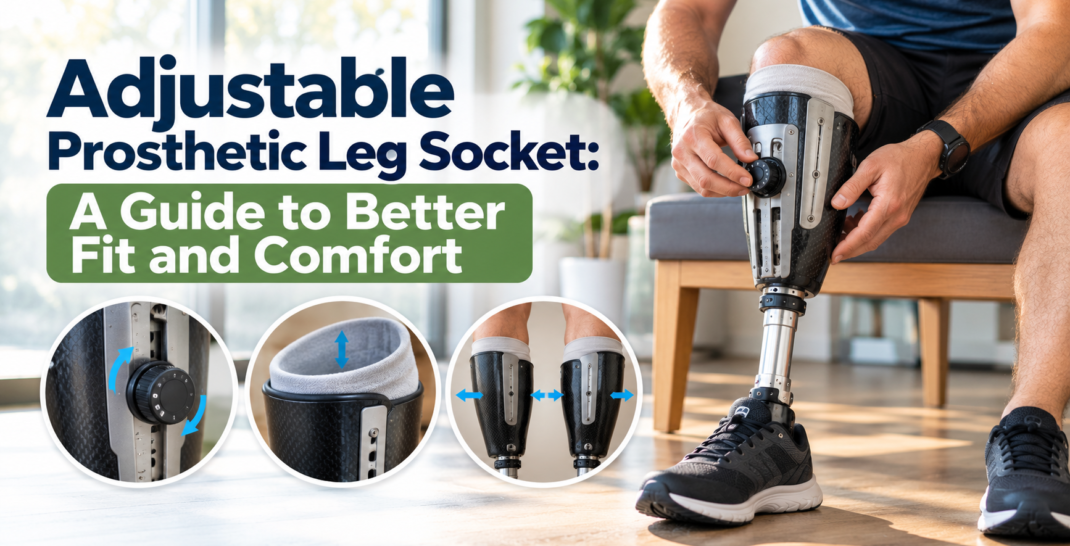
Ask a long-time prosthesis user what ruins their day, and the answer is rarely the knee or the foot. It’s the socket. Too tight by lunch, too loose by dinner, rubbing the same spot as last Tuesday. At Amputee Clinic, we hear this constantly, and nothing is actually broken. Your body just changes size, and a rigid socket doesn’t. That gap is exactly what an adjustable prosthetic leg socket is designed to close.
Here’s what it is, who it helps, how to adjust a prosthetic leg safely at home, and a few tips for adjusting to a new prosthetic leg while your body catches up.
Why a Socket Stops Fitting
The residual limb is not a fixed shape. Right after amputation, it can shrink dramatically. One figure often quoted in the research is a volume loss of up to 35% in below-knee limbs, mostly as post-surgical swelling settles. That’s a huge range to cover with one piece of carbon or plastic.
Then there’s the daily swing. Studies have measured volume shifts of up to 6.5% over short periods of activity alone. Salty food, a long day on your feet, a hot afternoon, or a diabetes flare can all nudge the number. Fitting researchers have long treated a 5% socket volume mismatch as a good fit and 10% as merely acceptable. Your limb can wander past both before the day ends.
Skin pays the price when it does. A systematic review published in the Journal of NeuroEngineering and Rehabilitation notes that skin damage affects somewhere between 36% and 63% of lower limb prosthesis users, and that poor fit is tied to people quietly giving up on the device. That’s not a small group, and it’s the reason this topic matters.
What an Adjustable Prosthetic Leg Socket Actually Is
An adjustable prosthetic leg socket does the same basic job as a traditional one, holding your limb and transferring load, but it lets you change its internal volume without a trip to the clinic. Depending on the design, that might mean a small dial you turn like a shoelace tightener, panels that slide in and out, straps with buckles, or inflatable bladders.
The same review looked at 50 published articles and 63 patents and found 35 different adjustable designs in the literature, with 16 commercial versions from 14 companies. Circumferential adjustment, tightening around the limb, turned out to be the most common approach in the industry, covering about three-quarters of commercial designs. Inflatable bladders show up in roughly 40% of research designs but in only one commercial product. So plenty of clever ideas exist on paper, but a smaller set has made it into clinics.
One honest caveat: most clinical studies on these sockets are small, with a median of around ten participants. A randomized controlled trial on transfemoral adjustable-volume sockets has looked at comfort and quality of life, which is encouraging, but the field is still young. It’s a strong tool for the right person, not a guaranteed upgrade for everyone.
Fixed Socket vs. Adjustable Socket
| Feature | Traditional Fixed Socket | Adjustable Prosthetic Leg Socket |
| Volume changes during the day | Handled with sock ply only | Handled with dial, panel, or strap adjustments |
| Clinic visits for minor fit changes | Often needed | Fewer, since small tweaks happen at home |
| Best for | Stable limb volume, low maintenance | Fluctuating volume, active days, early recovery |
| Weight and complexity | Lighter, fewer parts | Extra hardware, slightly more to clean and check |
| Cost | Generally lower | Often higher upfront |
| Who adjusts it | Prosthetist | You, within limits your prosthetist sets |
Neither column wins every time. Someone with a very stable limb may never need the extra parts. Cost is usually the deciding factor, so it’s worth reading Does Insurance Cover Prosthetics? before you commit to a design.
How to Adjust a Prosthetic Leg Without Making Things Worse
People get nervous here, and fair enough. Some changes are yours. Others belong to your prosthetist.
What you can usually handle yourself:
- If the socket feels loose, add a sock. If it feels tight or you notice pressure, take one off. Change one ply at a time and walk around before deciding.
- On an adjustable design, make small turns, a click or two, and test before going further.
- Many people tighten slightly in the morning and loosen later, or the reverse. Notice your own pattern for a week and write it down.
What should go to your prosthetist:
- Anything involving the socket shape itself, trimming, heating, or re-gluing
- Alignment changes to the pylon, foot, or prosthetic knee
- A fit problem that comes back every day even after small adjustments
- Sores, blisters, or redness that lasts more than 15 to 20 minutes after removal
A rule worth remembering: if you can describe a problem as “it feels a bit looser than yesterday,” it’s probably a sock or dial issue. If you describe it as “it hurts in one specific spot every time,” it’s a clinic visit.
Tips for Adjusting to a New Prosthetic Leg
Even a perfect socket feels strange for the first few weeks, since your skin, muscles, and brain are all learning at once. A few things help.
Build wear time slowly. Many clinics start people with short sessions, 30 to 60 minutes, and add time daily while checking skin after each session. Most people reach a full day within a couple of weeks, though some need longer, and that’s fine.
Check your skin every time you take the leg off. Redness that fades within 15 to 20 minutes is usually acceptable. Redness that lingers, or any blister, is a signal to slow down.
Keep a simple log of sock ply, plus how the leg felt at noon and at night. After ten days, your prosthetist has real patterns to work with, and you’ll know which prosthetic supplies, like extra socks or liners, are worth keeping on hand.
Keep your routine steady. Big swings in salt, water, or activity change limb volume, and an unpredictable week makes for an unpredictable socket.
Don’t tough it out. A tight spot you ignore on Monday can be an open sore by Friday.
Who Benefits Most From an Adjustable Prosthetic Leg
Not everyone needs an adjustable prosthetic leg, but a few groups tend to gain the most. People in the first year after amputation, when volume is still settling, often see the biggest benefit. So do people whose limbs swing a lot because of diabetes, kidney conditions, or heavy activity. Above-knee users sometimes find them especially useful, since a transfemoral socket has more soft tissue that can shift through the day. If that’s you, it’s worth looking at above the knee prosthetics options that include adjustable features.
Getting the Fit Right at Amputee Clinic
At Amputee Clinic, we start with your limb, not a catalog. We look at how your volume moves across a typical day, how active you are, and what your skin tolerates, and then we decide whether an adjustable socket makes sense or whether a refined conventional socket will do the job. If you’re searching for custom prosthetics, that kind of individual fitting is exactly what we mean by custom.
We also treat the first months as a conversation. A socket that was right in March may need attention by June, and a quick check beats recovering from a skin problem.
Final Thoughts
A socket that fits at 8 a.m. and hurts by 4 p.m. isn’t a failure of willpower. It’s a mismatch between a changing body and a fixed shape, and adjustable designs exist to narrow that gap. Whether you end up with one or stick to sock management, the habits are the same: small changes, honest skin checks, and speaking up early.
If your socket feels off, or you’re curious whether an adjustable prosthetic leg socket suits your limb, reach out to the team at Amputee Clinic. We’ll look at the fit with you and build a plan that makes everyday wear more comfortable.
Frequently Asked Questions
1. What is an adjustable prosthetic leg socket?
An adjustable prosthetic leg socket is a socket designed so its internal volume can be changed using dials, panels, straps, or inflatable inserts. It helps accommodate the normal daily swings in limb size that a fixed socket can’t.
2. How do I adjust a prosthetic leg if it feels loose?
Start by adding one sock ply and walking around for a few minutes. If you have an adjustable socket, tighten the dial or strap a small amount. If the looseness keeps returning or the leg shifts noticeably when you walk, see your prosthetist, because the socket itself may need work.
3. Can I use an adjustable prosthetic leg all day?
Yes, many people do. The adjustability is actually meant to make long wear easier by letting you respond to volume changes as they happen. Build up gradually when the leg is new, and check your skin each time you remove it.
4. What are the best tips for adjusting to a new prosthetic leg?
Build wear time slowly, check your skin after every session, and log your sock ply. Many people reach a full day of wear in about two weeks, but feeling natural can take months, and above-knee users often need longer. Regular follow-ups keep the process smooth.
5. Is an adjustable prosthetic leg socket better than a traditional one?
It depends on your limb. Adjustable designs tend to help people whose volume fluctuates or who are early in recovery. Someone with a stable limb and a good conventional socket may not need one. Your prosthetist can help you decide based on how your limb behaves day to day.