

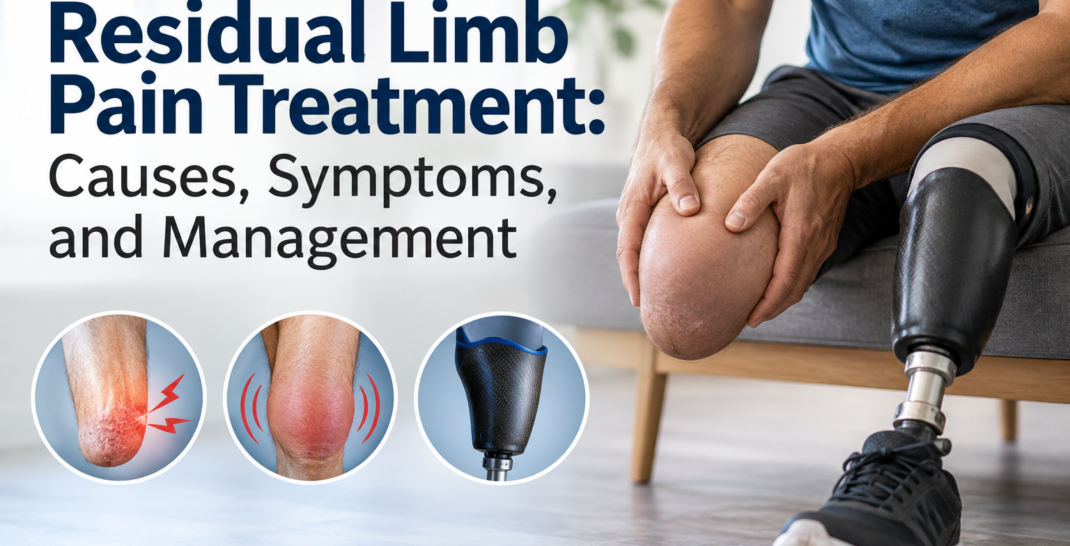
Let’s start with a confession. Most people leave the hospital knowing how to change a dressing and roughly when the prosthesis is coming, and almost nothing about the pain that shows up afterward. Then it does show up. A dull throb after dinner. A zap that makes you jump. An ache that only starts once the leg has been on for three hours. If that’s you right now, you’re in very common company, and we see it every week at Amputee Clinic.
This piece covers what’s usually behind residual limb pain, what to do about the swelling that goes with it, and which signs mean you should pick up the phone today rather than next week.
Residual Limb Pain vs. Phantom Limb Pain
They get mixed up constantly, so quick definitions. Residual limb pain happens in the part of your limb that’s still attached. Phantom limb pain is felt in the part that isn’t. Same person, sometimes the same afternoon.
Numbers differ depending on the study, but reports of phantom sensations commonly land somewhere between 60 and 80 percent of amputees, and a large share also deal with pain in the remaining limb. Older articles call it “stump pain.” You’ll still hear that word in waiting rooms, and honestly nobody minds.
The reassuring bit is that pain tends to peak early. Plenty of people find it eases across the first year, particularly once someone works out what’s causing it.
What Causes It?
Rarely just one thing. The usual suspects:
Healing tissue. Your body is rebuilding after surgery, so early soreness is expected. It should get a little better each week, not worse.
Neuromas. A cut nerve can regrow as a small tangled knot. Press on it and you get burning or shooting pain, sometimes out of nowhere.
Bone spurs. Extra growth at the end of the bone can dig into the soft tissue around it, especially when you load the limb.
A socket that doesn’t fit. Probably the most fixable cause on this list. If it’s tight in one spot or loose in another, you’ll get pressure marks, blisters, and a deep ache that builds through the day.
Infection. Heat, redness, drainage, fever. Different category, urgent.
And then swelling, which quietly makes all of the above worse.
Residual Limb Swelling: What’s Normal and What Isn’t
Swelling after amputation is expected. The surgery causes inflammation and fluid collection, and an amputee’s puffy limb in the first weeks is simply what healing looks like. Nobody should panic over that alone.
The trouble starts when you’re trying to wear a prosthesis. An amputee’s swollen stump changes size, and a socket built for yesterday’s limb can be wrong by tomorrow. Salt, heat, a long day on your feet, sleeping with the limb hanging down, all of it can shift the volume. Then pressure builds where it shouldn’t, and pain follows.
What helps? Compression, mainly. A shrinker sock or elastic wrap, put on the way your team demonstrated, pushes fluid out and shapes the limb. Raising the limb (ask your surgeon how) helps drainage. Wearing your prosthesis as directed keeps volume steadier once you’re fitted. Skipping it for days tends to bring the swelling back.
Watch for the odd one out. If residual limb swelling appears suddenly, mostly on one side, or comes with warmth and redness, get it checked. That pattern can mean infection or a clot.
And please don’t rest the limb bent over a pillow for hours because it feels nicer. Long stretches in a bent position can tighten the joint permanently. Ask what safe positioning looks like before it turns into habit.
Residual Limb Pain Treatment Options
Most people don’t fix this with a single move. They stack a few. A sensible care team tries the gentle options first and only escalates if needed.
|
Option |
What Happens |
Best For |
|
Socket adjustment or rebuild |
Remove pressure spots, reshape for the current limb |
Pain from fit or shrinking volume |
|
Compression and shaping |
Shrinker socks, wraps, liners |
Swelling, early volume control |
|
Medication |
Nerve-pain drugs or anti-inflammatories from a physician |
Neuroma and nerve-type pain |
|
Physical therapy |
Desensitization, massage, strengthening |
Oversensitive skin, muscle imbalance |
|
Mirror therapy |
A mirror tricks the brain into “seeing” the missing limb move |
Phantom and mixed pain |
|
Nerve block or injection |
Targeted injection near the painful nerve |
Neuromas that won’t quit |
|
Surgical revision |
Remove a neuroma or spur, reshape the limb |
When other routes haven’t worked |
Medication is a conversation with your doctor. A drug that quiets one person’s nerve pain may do nothing for someone else, so nobody should copy a friend’s prescription.
One free option people overlook: desensitization. You tap, rub, and brush the limb with different textures, a bit each day, so the nerves get used to normal touch again. Feels silly for the first week or two. Then it usually stops feeling silly.
Why the Socket Deserves Most of Your Attention
If I could tattoo one idea on every new amputee’s arm, it would be this: a lot of limb pain is a fit problem wearing a disguise. Limbs change shape, mostly in the first year, and a socket that felt great in month two can be rubbing you raw by month five. Nothing went wrong. Bodies just do that.
For people using prosthetics above the knee, it matters even more, because the socket carries so much of your weight and holds a longer lever steady. A tiny error at the top becomes a big one by the time you’re walking. At Amputee Clinic we check pressure patterns and adjust before a small irritation becomes a wound, or before someone quietly starts leaving the leg in the closet.
Components count as well. A prosthetic knee that’s set up wrong, or simply doesn’t match how active you are, changes how force travels up into the limb. You can end up with residual limb pain even when the socket is perfect. If your pain flares with particular movements, mention that at your next visit.
Signs You Shouldn’t Wait
Call a doctor promptly if you have fever or chills, spreading redness or heat, drainage or a bad smell, sudden swelling on one side, sores that aren’t closing, or pain that keeps climbing when it should be fading. Early treatment for infection and skin breakdown is dramatically easier than late treatment.
Frequently Asked Questions
- What is the best residual limb pain treatment?
There’s no single winner, because the right residual limb pain treatment depends on what’s causing the pain. Fit issues need socket work, nerve pain may respond to medication or injections, and sensitivity often improves with desensitization and therapy.
- How long does residual limb swelling last?
It’s heaviest in the first few weeks, but residual limb swelling can come and go for months, sometimes a year or longer, while the limb matures. Compression and regular prosthetist visits keep it manageable.
- Is swelling after amputation normal?
Usually, yes. Swelling after amputation is part of healing. See a professional if it shows up suddenly, sits on one side, or arrives with heat, redness, or fever.
- Why does my amputee swollamputee’sp hurt more at night?
Common complaint. There are fewer distractions at night, so your brain focuses harder on pain signals, and fluid shifts once you lie down. If an amputee’s swollen stump regularly wrecks your sleep, tell your care team. Positioning, compression changes, or medication tweaks may help.
- Can a bad socket fit make residual limb pain worse?
Yes, quickly. Pressure and friction cause sores, deep aching, and swelling, and those feed each other. If pain starts or gets worse after a new fitting, or as your limb changes, a socket adjustment is usually step one.
Final Thoughts
Pain after amputation is discouraging, especially when it seems to come from nowhere. But it usually has a cause, and that cause can usually be found and dealt with. Swelling settles, sockets get refined, nerves quiet down, and most people end up more comfortable than they expected to be.
If you’re stuck with pain that won’t ease, swelling that won’t settle, or a socket that just feels wrong, reach out to the team at Amputee Clinic. We’ll look at what’s going on and help you build a plan. This article is general information and doesn’t replace advice from your own physician.