

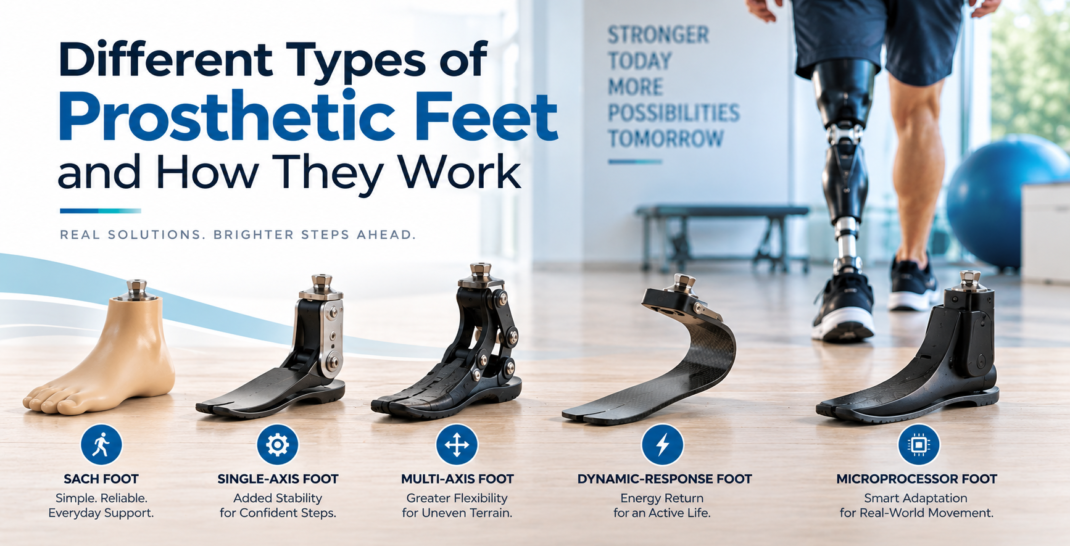
Ask ten amputees what kind of prosthetic foot they have, and you’ll probably get ten different answers, plus a story about how they landed on it. That’s not an accident. At Amputee Clinic, we fit everyone from retirees who mostly walk to the mailbox and back to former athletes trying to get back on a trail, and honestly, the foot that changes one person’s life can feel completely wrong on someone else.
So here’s the real breakdown: what the different foot types actually do, how they feel underfoot, and how a prosthetist figures out which one fits a person’s actual life instead of just their limb.
Why the Foot You Choose Actually Matters
People tend to picture a prosthetic foot as a static block shaped like, well, a foot. It’s not. It’s the part of the whole system that has to absorb shock on every single step, help push the body forward, and ideally adapt to whatever surface you happen to be standing on. Get the wrong one and even a beautifully fitted socket won’t feel right. We’ve seen it happen.
Clinicians sort patients into what’s called a K-level, a functional mobility scale used pretty much everywhere in prosthetics, running from K0 (no real walking ability) up through K4 (high-impact, high-energy movement). That number matters a lot when someone’s looking for a prosthetic foot for active amputees specifically, because a foot built for one steady walking pace just won’t hold up if someone wants to jog, cut sideways, or hike uneven ground.
Walking Through the Main Prosthetic Foot Types
There’s no single “correct” foot here. Different designs solve different problems, and most prosthetists will tell you flat out that the best foot is whichever one matches the person’s actual daily demands, not whatever’s newest on the market.
SACH Feet (Solid Ankle Cushioned Heel)
This is about as simple as it gets. No moving joints at all. A soft rubber wedge in the heel compresses slightly the moment weight lands on it, roughly mimicking how a natural ankle gives a little early in a step. Underneath, the keel stays rigid, which means solid support at midstance but almost no side-to-side give.
SACH feet cost less than most alternatives, and there’s basically nothing mechanical inside to break. They tend to suit patients who walk at a fairly consistent pace on predictable ground, not the type chasing varied terrain or speed changes.
Single-Axis Feet
Add one basic hinge at the ankle and you get a single-axis foot. That small amount of up-and-down motion helps the sole meet the ground a touch faster than a SACH foot would, which stabilizes the knee earlier in the gait cycle. These often get recommended for above-knee amputees who need that extra bit of knee stability during the stance phase.
Multi-Axis Feet
Take that same hinge idea and let it move in more directions, some rotation, some side-to-side give, and you’ve got a multi-axis foot. That extra flexibility makes a real difference on curbs, slopes, and uneven ground. Older adults and anyone spending real time outdoors on inconsistent terrain tend to benefit here, since the foot adjusts a bit with every step instead of forcing whatever’s left of the ankle joint to do all the compensating.
Dynamic-Response Feet (Energy Storing)
This is where a prosthetic foot starts feeling less like medical equipment and more like performance gear. Dynamic-response feet, sometimes called ESAR feet (energy-storage-and-return), are built from flexible materials, carbon fiber usually, that compress under load and spring back on push-off. Part of the energy you put into each step actually comes back to you.
This category is usually the answer when someone asks about a prosthetic foot for active amputees. These feet handle varying speeds, support quick direction changes, and hold up over long distances better than the more basic designs. Most sports and running prosthetics you’ve probably seen are built on this exact principle, just with sharper curvature and tougher materials for higher-impact use.
Microprocessor Feet
At the top of the tech ladder are microprocessor-controlled feet. They use built-in sensors and a small onboard computer that reads walking speed, incline, and terrain as it happens, then adjusts ankle resistance in real time to match. Patients using these often report fewer stumbles, more confidence on stairs, and less socket discomfort by the end of a long day.
The catch? Cost, weight, and upkeep. These run on rechargeable batteries, need regular charging, and shouldn’t get fully dunked in water. They also sit near the top of the price range for prosthetic supplies, which is exactly why insurance paperwork and a documented functional need assessment matter before anyone commits to one.
Comparing the Main Prosthetic Foot Types
Foot Type | Best Suited For | Key Advantage | Common Limitation |
SACH | Lower-activity, steady-pace walkers | Inexpensive, durable, low maintenance | Little flexibility on uneven terrain |
Single-Axis | Patients needing extra knee stability | Faster foot-flat contact, added stability | Limited range of motion overall |
Multi-Axis | Active older adults, uneven terrain | Handles slopes, curbs, and rotation well | More moving parts than basic feet |
Dynamic-Response (ESAR) | Active amputees, varied speeds | Stores and returns energy, natural gait | Higher cost than basic feet |
Microprocessor | High-mobility users wanting adaptive support | Real-time terrain and speed adjustment | Requires charging, higher cost, less water-resistant |
What About Partial Foot Amputations?
Not every amputation takes the whole foot, and the options here look pretty different. Sometimes a partial foot prosthetic is nothing more than a custom shoe insert that fills the missing space. Other times it’s an ankle-foot orthosis strapped onto what remains for added support. Silicone partial foot devices are another route, built to restore both function and a more natural look for people who’ve lost part, not all, of the foot’s structure.
Because partial foot amputations change balance and push-off mechanics differently than a full foot or below-knee amputation would, these devices almost always get custom-built rather than pulled off a shelf and adjusted.
How a Prosthetist Actually Picks One
This isn’t guesswork, and it’s definitely not “whatever’s newest wins.” A prosthetist usually weighs several things together before recommending anything:
Activity level and daily routine come first, including work demands and hobbies that might not seem obviously relevant but often are. Body weight matters too, since heavier loads put more stress on a keel or a set of springs than lighter ones do. Residual limb length and amputation level shape what’s even physically possible. Terrain the person actually walks on day to day counts for a lot, more than most people expect going in. And long-term goals, whether that’s getting back to running or just moving comfortably around the house, tend to guide the whole decision more than any single spec sheet.
At Amputee Clinic, this conversation happens before we ever pull up a catalog of prosthetic feet options. Starting with someone’s actual life, not a product list, tends to produce a much better long-term fit.
Frequently Asked Questions
1. What are the main types of prosthetic feet available today?
The main prosthetic foot types include SACH, single-axis, multi-axis, dynamic-response, and microprocessor feet. Each one targets a different level of mobility and terrain demand, which is why a prosthetist looks at activity level and daily routine before recommending one over another.
2. What’s the real difference between the different types of prosthetic feet on the market?
It mostly comes down to flexibility, energy return, and how much tech is built in. A basic SACH foot offers stability with zero moving parts, while a microprocessor foot uses sensors to adjust itself to terrain automatically. That gap is exactly why the different types of prosthetic feet aren’t interchangeable from one patient to the next.
3. Which prosthetic foot type actually works best for active amputees?
Dynamic-response, or ESAR, feet are usually the answer for a prosthetic foot for active amputees. Their carbon-fiber build stores and releases energy with every stride. Most sports-specific and running prosthetics you’ll come across are built on this same energy-storing idea, just tuned for higher-impact movement.
4. How does a prosthetist figure out which prosthetic foot type fits a specific patient?
They typically lean on a functional mobility scale alongside things like body weight, terrain, and long-term goals to land on the right prosthetic foot type. Someone who mostly walks indoors needs something very different from someone hoping to get back to hiking or running.
5. Can a partial foot amputation use the same prosthetic foot types as a full amputation?
Not really. A partial foot prosthetic supports only the missing portion of the foot, unlike the full prosthetic foot types built for complete below-ankle amputations. These devices get custom-built almost every time, specifically to preserve balance and natural push-off.
Final Thoughts
There’s no single “best” prosthetic foot out there, just the one that actually matches a person’s body, activity level, and goals. Someone recovering from surgery who mainly needs to move safely around the house is working with a completely different set of needs than someone training to get back into competitive sports, and that range is exactly why so many prosthetic foot types exist in the first place.
If you’re not sure which option fits where you’re at right now, reach out to the team at Amputee Clinic. We’ll go through your activity level, your terrain, your goals, all of it, together, and help you land on a foot that actually works with your life instead of against it.