

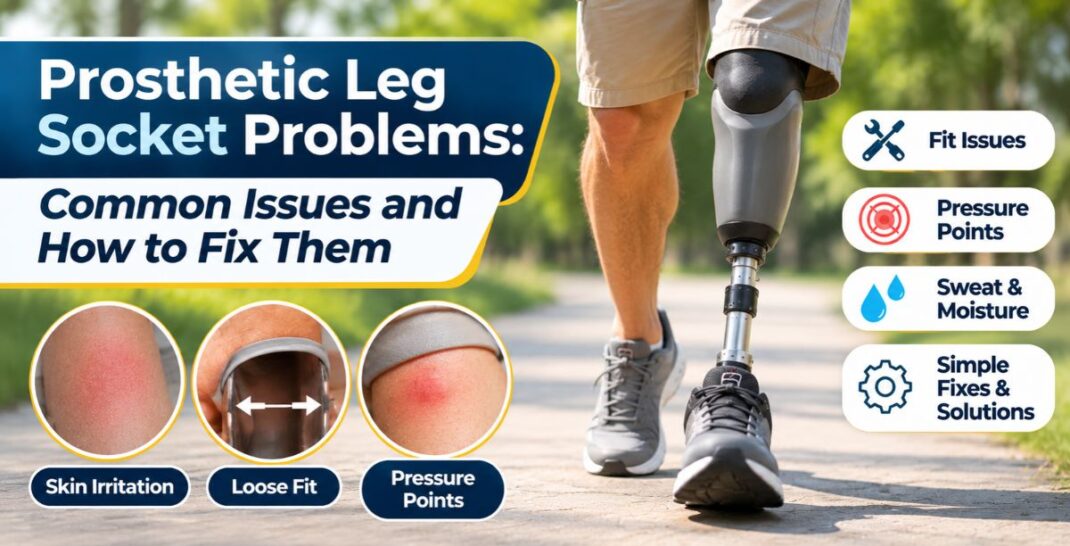
Ask someone how their prosthesis is going, and you’ll often hear “fine.” Keep talking, though, and the real answer leaks out. It rubs a bit near the end of the day. It’s slipped since the weather turned. There’s a sore spot they’ve decided to ignore. Prosthetic leg socket problems almost never start with a bang. They build slowly, people adapt around them, and by the time someone books an appointment, the problem has been running for weeks.
This guide covers what goes wrong, why, what you can reasonably try on your own, and where the line sits between “tweak it” and “call your prosthetist.”
Why a Socket Stops Fitting
Start with the basic mismatch: the socket is rigid, and your limb is not. In the months after amputation, a residual limb can shrink a lot. Figures in the research run as high as 35% volume loss in below-knee limbs as the swelling goes down. Even after that settles, the limb keeps changing. Researchers have recorded shifts of up to 6.5% over short periods of activity, and the usual suspects are boring ones, like a salty dinner, a hot afternoon, a long day on your feet, or a few pounds gained or lost. Merck’s clinical guidance notes that even small body weight changes can alter how a socket fits.
For perspective, fit researchers often treat a 5% volume mismatch as a good fit and 10% as acceptable. A limb can drift past both before dinner. And the skin is what pays for it: a systematic review in the Journal of NeuroEngineering and Rehabilitation puts skin damage at somewhere between 36% and 63% of lower limb prosthesis users.
If that sounds like you, you haven’t done anything wrong. It’s what bodies do.
Common Prosthetic Leg Socket Problems at a Glance
| Problem | What You Notice | Usual Cause | Typical Fix |
| Too loose | Slipping, limb sliding, fit that worsens through the day | Volume loss, weight loss | Add a sock ply, adjust fit, consider an adjustable design |
| Too tight | Pressure, swelling, pins and needles | Swelling or weight gain | Remove a ply, rest the limb, get it checked |
| Pressure points | Sore spot, often at the limb end or over bone | Uneven pressure, shifted fit | Padding or socket modification |
| Skin irritation or blisters | Redness, burning, rash | Friction, moisture | Clean and dry skin, check liner and fit |
| Heat and sweat | Wet skin, odor, soft skin | Moisture trapped in the socket | Wicking liner, daily cleaning |
| Warty bumps at the limb end | Rough, painful, sometimes leaking growths | Limb not contacting the socket bottom | See your prosthetist right away |
| Pain elsewhere in the body | Knee, hip, or back ache, uneven gait | Alignment or fit imbalance | Professional alignment check |
Treat it as a map, not a diagnosis. A few of these overlap.
Too Loose, Too Tight
These two cause most of the complaints, and they’re opposites with a shared cause: your limb changed size.
A loose socket gives itself away through movement. The limb slides, the leg lags a beat on each step, or everything feels fine at breakfast and sloppy by four. It isn’t harmless, either. Extra room lets pressure concentrate at the end of the limb and over bony spots. Adding a sock ply is the usual first move. Walk around on it before deciding if it worked. If you keep needing another ply every week or two, the socket itself has run out of road.
A tight socket is the mirror image. Swelling, weight gain, or a hot day can turn something that fit last week into a clamp. Merck’s guidance points out that a too-tight socket can restrict circulation, which adds swelling and pressure at the limb end. Try taking a ply off and resting the limb. Numbness, a change in skin color, or throbbing that doesn’t ease means the prosthesis comes off and your prosthetist gets a call.
Pressure Points, Blisters, and Skin Breakdown
A pressure point usually announces itself as a warm, sore spot that stays red after you take the leg off. Redness that fades within 15 to 20 minutes is generally acceptable. Anything that lingers or burns is your skin asking for a change.
Early irritation left alone turns into blisters, and blisters turn into open sores. The sensible move is to stop wearing the leg through a spot that’s breaking down, keep it clean, and get the fit looked at before it comes back.
One warning for people with diabetes or nerve damage: reduced sensation means pain won’t warn you in time. Merck recommends removing the prosthesis and checking skin several times a day in that case, not once.
Heat, Sweat, and Odor
A socket and liner make a warm, closed space, which is great for suspension and rough on skin. Moisture softens skin and gives bacteria and fungi a place to thrive. Tenderness, redness, pus, or a bad smell are all worth taking seriously.
The general guidance is to wash the limb with mild soap and rinse well twice a day, more if you sweat heavily. Clean the liner daily, let it dry completely, and keep a spare so you’re never pulling on a damp one. If that routine feels like too much hassle, the right prosthetic supplies, such as a second liner, moisture-wicking socks, or cleaners approved for your liner material, make it easier.
Warty Bumps at the End of the Limb
This one gets its own heading because people miss it. Rough, warty bumps at the end of the limb, especially painful or leaking ones, point to a condition called verrucous hyperplasia. It tends to develop when the limb end isn’t making firm contact with the bottom of the socket, so suction pulls tissue the wrong way.
Call your prosthetist right away. According to Merck, taking the prosthesis off for about a week and adjusting the socket usually clears it within 2 to 4 weeks, and a doctor should look at it if it doesn’t improve by then. Untreated, it can lead to a serious infection.
When It’s Not Your Skin: Alignment and Gait
Sometimes the limb feels fine, and something else hurts. A sore hip, a nagging knee, a back that’s complaining. Even a slight alignment error changes how force travels up through the body, and the pain shows up far from the socket. If you’re walking “off” or favoring one side, say so. It matters even more for people using above the knee prosthetics, where a longer lever magnifies small errors.
What’s Safe to Try Yourself
Adding or removing a sock ply one at a time, resting a swollen limb, cleaning skin and liner, and checking your skin after every wear session are all fair game. Anything involving the shape of the socket, trimming, heating, re-gluing, or alignment belongs to your prosthetist, and so does any problem that returns daily after small adjustments. Open skin is always a call, never a wait-and-see.
How Often to Get the Socket Checked
Clinics commonly recommend evaluations every 6 to 12 months, and sooner if you’re active or something feels different. Össur suggests at least every six months. Limbs change quietly, so a socket that was right a year ago could be causing trouble today without announcing it.
When adjustments run out, the next step is a new socket built around your limb as it is now, which is what custom prosthetics work is for. If cost is what’s holding you back, read Does Insurance Cover Prosthetics? before assuming a refit is out of reach.
Frequently Asked Questions
- What are the most common prosthetic leg socket problems?
A socket that’s too loose or too tight, pressure points, blisters and skin irritation, excess sweating, and alignment-related pain. Most trace back to changes in limb volume.
- How do I know if my prosthetic socket is too loose?
You’ll feel slipping, the limb sliding as you walk, or a fit that gets worse as the day goes on. A sock ply often helps short-term. If you keep needing more, the socket needs adjusting.
- Can a bad socket cause pain in other parts of my body?
Yes. Poor fit or small alignment errors can change your gait and strain your knee, hip, or back. Mention pain away from the limb to your prosthetist.
- Should I keep wearing my prosthesis if it hurts?
Not if the pain is sharp, a sore spot lingers, skin is open, or there are signs of infection. Take it off and call your prosthetist. Mild early-adjustment discomfort is different, but it still needs a check if it doesn’t ease.
- How often should my socket be checked?
Many clinics suggest every 6 to 12 months, and more often early on, when limb volume is still shifting, or whenever problems appear.
Final Thoughts
Prosthetic leg socket problems are discouraging, especially after all the work it takes to get comfortable on a leg. They’re also common; they usually have a findable cause, and most can be fixed. The habit that helps most is the dull one: notice early, change one thing at a time, and speak up before a small irritation turns into a big one.
If your socket feels off, or you can’t tell whether what you’re feeling is normal, reach out to the team at Amputee Clinic. We’ll look at the fit with you and work out a plan.