

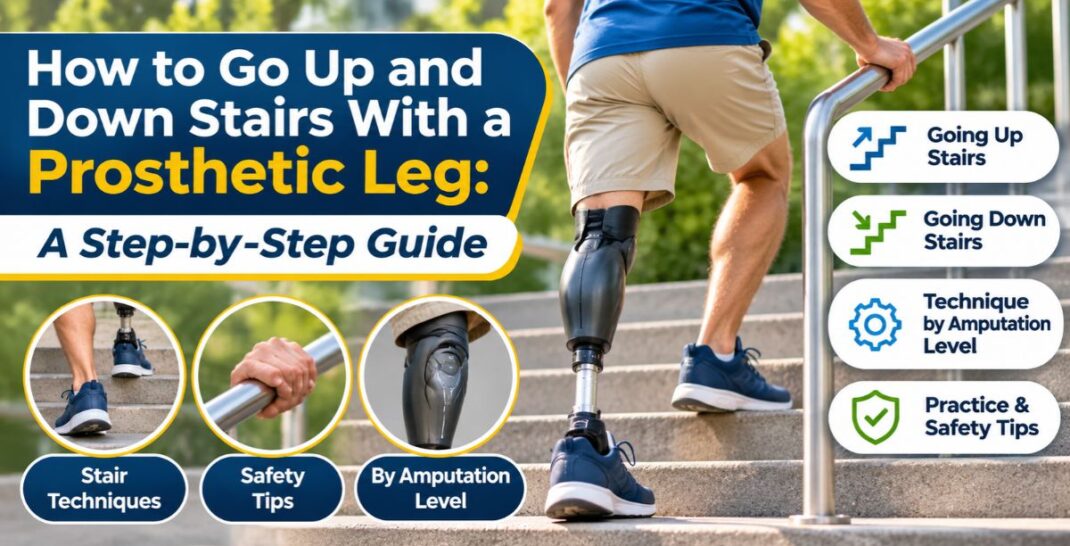
Stairs are where people with a new prosthesis lose their nerve. Level ground feels manageable after a few weeks, then you hit the front steps, a restaurant with a split level, or the staircase in your own house, and suddenly every plan you had about walking confidently falls apart. That reaction is normal. Stairs ask more of a prosthesis than almost anything else in daily life, because the knee has to bend under load and your body has to trust a leg it can’t fully feel.
Here’s how to go up and down stairs with a prosthetic leg, how the technique differs depending on your level of amputation, and how to practice without turning the staircase into a gamble.
Why Stairs Feel So Much Harder
On flat ground, a prosthesis mostly has to swing forward and hold your weight. On a staircase, it has to lift you, lower you in a controlled way, and stay stable while one foot is on a different level from the other. If you’ve lost a knee, a mechanical or microprocessor joint is doing work your muscles used to do on instinct. If you’ve lost a foot or ankle, the push-off and the fine control that normally happen in your ankle are partly gone.
Falls are the real concern. In one study of 66 ambulatory people using a lower limb prosthesis, 57.6% reported at least one fall in the previous 12 months, with 90 falls reported in total. Stairs weren’t the biggest source, since level-ground walking caused most of them, but roughly one in ten falls involved stairs. So the risk is real without being a reason to avoid stairs altogether.
The Basic Rule: Sound Leg Up, Prosthesis Down
For most people with an above-knee prosthesis, the standard approach is called step-to. Going up, you lead with your natural (sound) leg and then bring the prosthetic leg up to meet it on the same step. Going down, you do the reverse: the prosthesis goes down first, and the sound leg follows to meet it. Propel Physiotherapy notes that most people with an above-knee amputation use this step-to method.
A quick way to remember it: up with the good, down with the prosthesis. It feels backwards the first time, because on the way down you’re asking the prosthetic leg to take your weight while the knee has to control the descent. That’s exactly why a handrail matters so much.
Going Up the Stairs, Step by Step
- Hold the handrail. Use it on the side that gives you the best support. If there’s a rail on both sides, use both if you need to.
- Stand close and square to the step. Don’t start at an angle or too far back.
- Lead with your sound leg. Place your natural foot firmly on the next step.
- Straighten up and push. Use your sound leg and the rail to lift your body, keeping your trunk upright.
- Bring the prosthesis up beside it. Swing it up and set it on the same step, then pause for a second before the next one.
- Repeat, one step at a time. Speed comes later. Control comes first.
Going Down the Stairs, Step by Step
- Hold the handrail before you move. Going down is usually the harder direction, so don’t skip this.
- Stand near the edge of the step. Your heel can overhang slightly if that feels more secure, but never your whole foot.
- Lead with the prosthesis. Place it on the step below with a controlled lowering motion.
- Shift your weight onto it gently. Let the knee or ankle do its job, and let your hands do the balancing.
- Bring the sound leg down to meet it. Pause before the next step.
- Don’t look away from the stairs. Eyes down, no phone, no carrying anything in both hands.
How It Differs by Level of Amputation
| Amputation Level | Typical Approach | Key Challenge |
| Above-knee (transfemoral) | Step-to, handrail, sound leg up, prosthesis down | Controlling the prosthetic knee during descent |
| Below-knee (transtibial) | Often step-to at first, with many people progressing toward alternating steps as strength and control improve | Limited ankle control, pressure on the residual limb |
| Partial foot | Depends on the device and remaining foot function | Push-off and balance at the forefoot |
| Microprocessor knee users | Step-over-step becomes more realistic | Learning how the knee responds before relying on it |
Treat the table as a general guide only. Your physical therapist and prosthetist set the plan for your body and your device.
What About Step-Over-Step?
Step-over-step, the way people without a prosthesis climb stairs, is the goal for many. Propel Physiotherapy notes it’s most easily achieved with a microprocessor knee, which senses movement and adjusts resistance as you go. That’s one reason the type of prosthetic knee matters so much for stair confidence.
There’s some research behind that. In a retrospective study of 1,486 inpatient rehabilitation stays involving people with above-knee amputations, microprocessor knees were linked to a lower fall rate (1.19 per 1,000 patient-days) than fluid-controlled knees (3.51). To be fair, that study looked at falls during inpatient rehab generally, not stairs specifically, and the authors say it’s unclear how well the results carry over to people living at home. Still, it’s a useful hint that the knee you’re using affects your safety.
How to Practice Without Taking Risks
Don’t start with a full flight. Physical therapists typically begin with a single step, stepping up and down while holding a rail or support, then reduce hand support and increase step height as control improves. Only after one step feels solid does someone move on to full stairs.
A few habits that help:
- Practice with someone nearby, ideally your physical therapist at first.
- Use a sturdy handrail, not a wobbly banister or furniture.
- Wear your everyday shoes, not slippers or socks.
- Rest on a landing if your leg tires. Fatigue is when people slip.
- Keep your hands free. Carry a bag across your body, or make two trips.
Common Stair Mistakes to Avoid
Leading with the wrong leg is the most frequent one, and rushing is next. Skipping the handrail because “it’s only a few steps” is another. A poorly fitting socket gets exposed fast on stairs, since pressure rises when the limb is loaded at an angle.
Different feet behave differently on stairs, too. A flexible, responsive design can help with steps, while stiffer ones can feel awkward. If you’re curious whether your current foot is part of the problem, it’s worth reading about the different options for prosthetic feet and asking your prosthetist what suits your daily life.
Getting the Right Setup
Stairs are one more reason fit and components matter. A socket that’s comfortable on level ground can feel unstable on steps, and a knee that suits a quiet routine may not suit someone who tackles stairs all day. If you’re using above-the-knee prosthetics, it’s worth discussing stairs with your prosthetist, since knee choice and setup make a real difference.
At Amputee Clinic, we look at how you actually live: the stairs at home, the steps at work, the curb you hit every morning. That kind of fitting is what custom prosthetics are about. If cost is part of the decision, especially for advanced knees, Does Insurance Cover Prosthetics? is a good place to start.
Frequently Asked Questions
1. How do I go up and down stairs with a prosthetic leg safely?
Use a handrail, go one step at a time, and lead with your sound leg going up and your prosthesis going down. Build up gradually from a single step with your physical therapist, and don’t rush the pace.
2. Which leg goes first when going up stairs with a prosthesis?
For most people with an above-knee prosthesis, the sound leg goes first going up, and the prosthetic leg goes first going down. Your therapist may adjust this depending on your level of amputation and your prosthetic components.
3. I go up stairs normally, one foot per step, with a prosthetic leg?
Some people can, especially with a microprocessor knee or a below-knee prosthesis, once strength and control have improved. Many start with the step-to method and progress over time, guided by their therapist.
4. When can I start practicing stairs after getting a prosthetic leg?
Usually after you’ve gained confidence with standing, weight shifting, and level walking under supervision. Your physical therapist will start with a single step and progress from there, so ask them when you’re ready.
5. Why are stairs harder going down than going up?
Going down, the prosthesis has to take your weight while the knee or ankle controls a lowering motion, which demands more control and trust. That’s why a handrail and a slow pace matter so much on the way down.
Final Thoughts
Stairs feel like a big milestone because they are one. They’re also learnable, one step at a time, with the right technique, a good rail, and a setup that fits your body. Be patient with the first few weeks, practice with support, and speak up if something feels unstable.
If stairs are holding you back, or you’re unsure whether your current socket, foot, or knee is the problem, reach out to the team at Amputee Clinic. We’ll go through it with you and help you build a plan. This article is general information and doesn’t replace guidance from your physical therapist or prosthetist.